Dashboard
The web dashboard is experimental and not production-ready.
It is a Nuxt 4 + Vue 3 + PrimeVue + Vue Flow UI served from the Control Plane over HTTP (JSON under /api/v1/*, UI at / when embedded). Expect incomplete flows, breaking API changes, and rough edges.
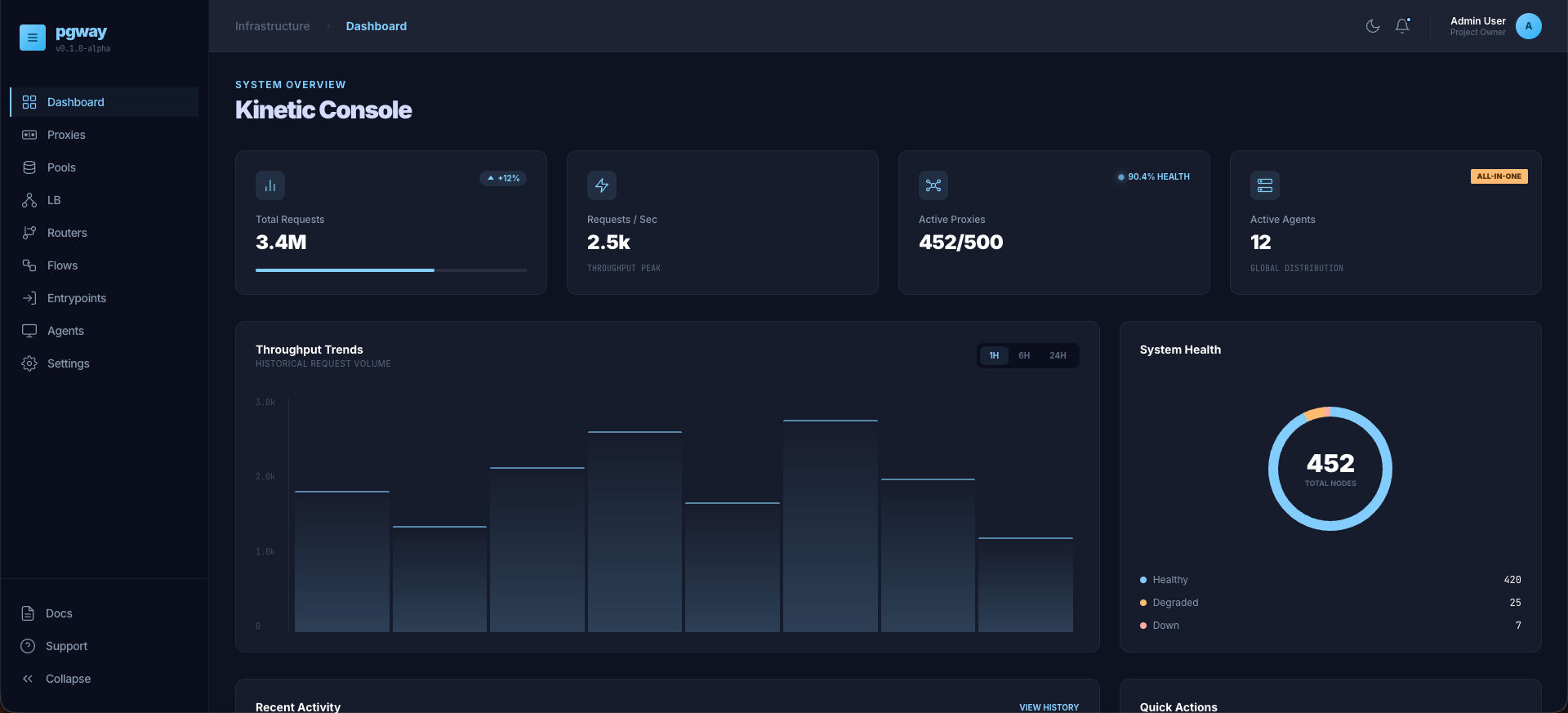
Demo / concept mock of the dashboard overview (not a guarantee of shipped UI).
Warning
Prefer pgctl + gRPC for real configuration and operations until the dashboard matures.
The dashboard HTTP surface requires a user session. Default listen is loopback (127.0.0.1:8081). Do not bind non-loopback without a trusted network / reverse proxy.
Using the embedded UI (release / Docker)
Release and Docker images build pgway / pgway-cp with -tags embeddashboard so the static UI is inside the binary.
- Run with
dashboard.enabled = true(default) and openhttp://127.0.0.1:8081/(same origin as/api/v1— no CORS needed). - Sign in at
/loginwith a CP user (afterpgctl init). - Untagged local
go build/make buildbinaries have no UI; use a release build,make build-embed, or the local UI development workflow below.
Status
Work is tracked on the Dashboard milestone. Epic: #21.
| Area | State |
|---|---|
| Core gateway (CP/DP, CLI, HTTP proxy, balancers) | Usable / tested |
| REST auth / secure defaults / rate limit | Done (#86); coverage ongoing (#87) |
| Dashboard login page / route guards / API client | Done (#22, #104) |
| REST Proxy / Pool / LoadBalancer / Router / Flow / Entrypoint CRUD | Done (dashboard resource pages + Flow editor) |
| REST agents list | Done (#115) — GET /api/v1/agents |
| REST users admin API | Done (#103) — admin-only /api/v1/users* |
| Dashboard Proxies / Pools / LB / Routers / Flows / Entrypoints CRUD | Done (slice of #105) |
| Flow visual editor (Vue Flow) + read-only YAML projection | Done (experimental) |
| Users admin UI (admin-only nav) | Done (#109) |
| Home agents panel + Agents page (read-only) | Done (#108) — register/revoke still via pgctl |
| YAML import/export | Planned (#106) |
| WebSocket foundation (management listener) | Planned (#101) |
| Overview charts / live logs / health panels | Later — depends on #14, #15, #9 |
Milestone: Dashboard on GitHub.
Local UI development (optional)
Only if you are hacking on the frontend (split process). Requires Bun or Node 20+ / Yarn.
cd frontend
yarn install   # or: bun install / npm install
yarn dev       # http://localhost:3000
The all-in-one / CP process must be running with dashboard.enabled = true (default) and dashboard.listen_addr reachable (default 127.0.0.1:8081).
- Add
http://localhost:3000todashboard.cors_allow_origins(credentials-enabled CORS). - Point the UI at
http://localhost:8081viaNUXT_PUBLIC_API_BASE(default) — uselocalhost, not127.0.0.1, so the httpOnly session cookie stays same-site. Embedded builds setNUXT_PUBLIC_API_BASE=(empty) for same-origin relative API calls. - Open
/login, sign in with a CP user (afterpgctl init/pgctl logincredentials). - Resource pages (same REST filters:
search, type/protocol chips, cursor pagination viapage_size/page_token): - Proxies (
/proxies) — create (URL or manual), edit, delete (blocked while a pool references the proxy). - Pools (
/pools) — static members or dynamicselector.allow; delete blocked while a load balancer references the pool. Weighted balancers require a static pool. - Load Balancers (
/load-balancers) — round-robin, weighted, least-bytes. - Routers (
/routers) — ordered match rules → balancer targets. - Flows (
/flows) — list + visual editor (/flows/{name}) for the pipeline graph. - Entrypoints (
/entrypoints) — listen host/port bound to a Flow. Detach in the editor deletes the entrypoint (stops the socket); the Flow remains. - Agents (
/home panel +/agents) — read-only list fromGET /api/v1/agents(active/passive/disconnected, hostname, version, last heartbeat). Register/revoke still viapgctl/ gRPC. - Users (
/users) — admin only (nav + route gate). List / create (adminormember; empty create password → one-timegenerated_password), delete (last admin blocked), password reset (new password required, same as gRPC). Members never see the nav item; hitting/usersredirects home.
Session & API client
- Login sets an httpOnly
pgway_tokencookie (primary) and keeps a same-tab Bearer fallback in memory for the token returned byPOST /api/v1/auth/login. The token is not stored inlocalStorage. useApisendscredentials: 'include'and attachesAuthorization: Bearer …when the in-memory token is present. JSON{ "error": "…" }bodies are surfaced as UI messages.- A 401 on a protected call clears the local session and redirects to
/login(login / session probe calls opt out of that redirect). - Agents (read-only):
GET /api/v1/agents— any authenticated user (admin/member); cursor pagination +searchlike other list endpoints. Status is derived server-side fromagent.heartbeat_threshold. - Admin-only user management:
GET/POST /api/v1/users,DELETE /api/v1/users/{username}, andPOST /api/v1/users/{username}/password(self-change:old_password+new_password; admin reset of another user:new_passwordrequired). Members receive 403.
Flow visual editor
- Canvas shows Entrypoint → Flow → (optional Router) → LoadBalancer → Pool → (static) Proxy.
- Palette: attach existing resources or create new ones; create router/balancer from the editor binds
flow.router_id/flow.balancer_id(Deploy to persist the Flow). - Sidebar: Node Settings (including unbind router/balancer, detach entrypoint) and a read-only multi-doc YAML projection (
kind/version/metadata/spec, apply-order sorted) compatible withpgctl apply. YAML is generated client-side today — not a server export API. - Dirty tracking + Deploy Changes applies staged resources in Proxy → … → Entrypoint order.
- Entrypoints already bound to another Flow cannot be stolen via the attach dialog (UI-only; Control Plane Apply still allows rebind).
See Authentication for REST login/logout/me and Configuration.
What to use instead
| Task | Tool |
|---|---|
| Apply / inspect resources | CLI (pgctl) |
| First bootstrap | First run |
| Auth & agents | Authentication |
Related
- Welcome — project-wide experimental notice
- Binaries & planes
- Entrypoint · Flow · Load balancing